You can learn tsugaru jamisen(shamisen) on skype from the master grade teacher of Oyama school who published yoshida brother's song score first in the
tsugaru jamisen world. .(Got permission from Japanese copyright management group Jasrac.)
Let's try authentic Japanese sound!
http://www.shamimaster.com/lesson.html
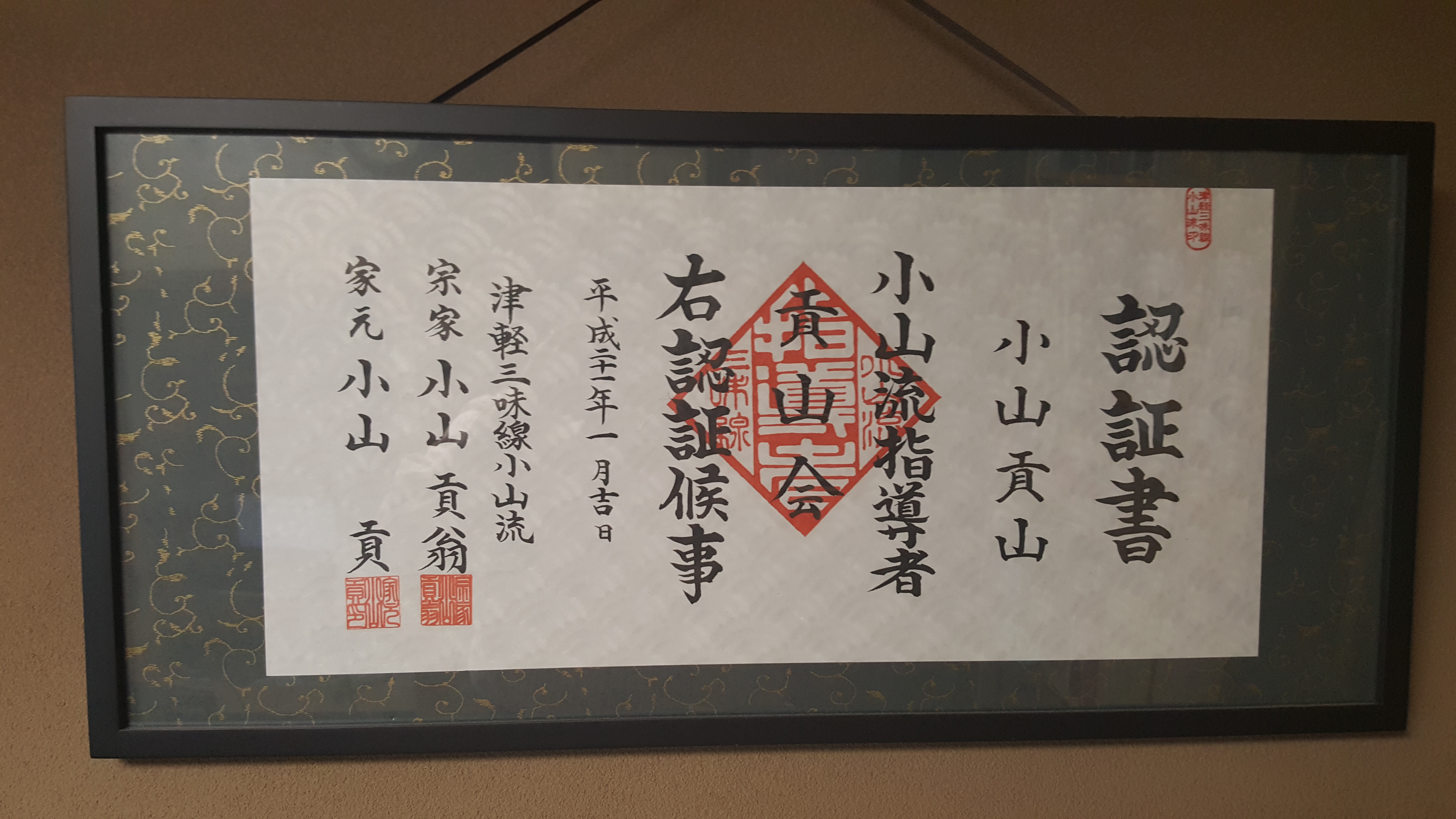
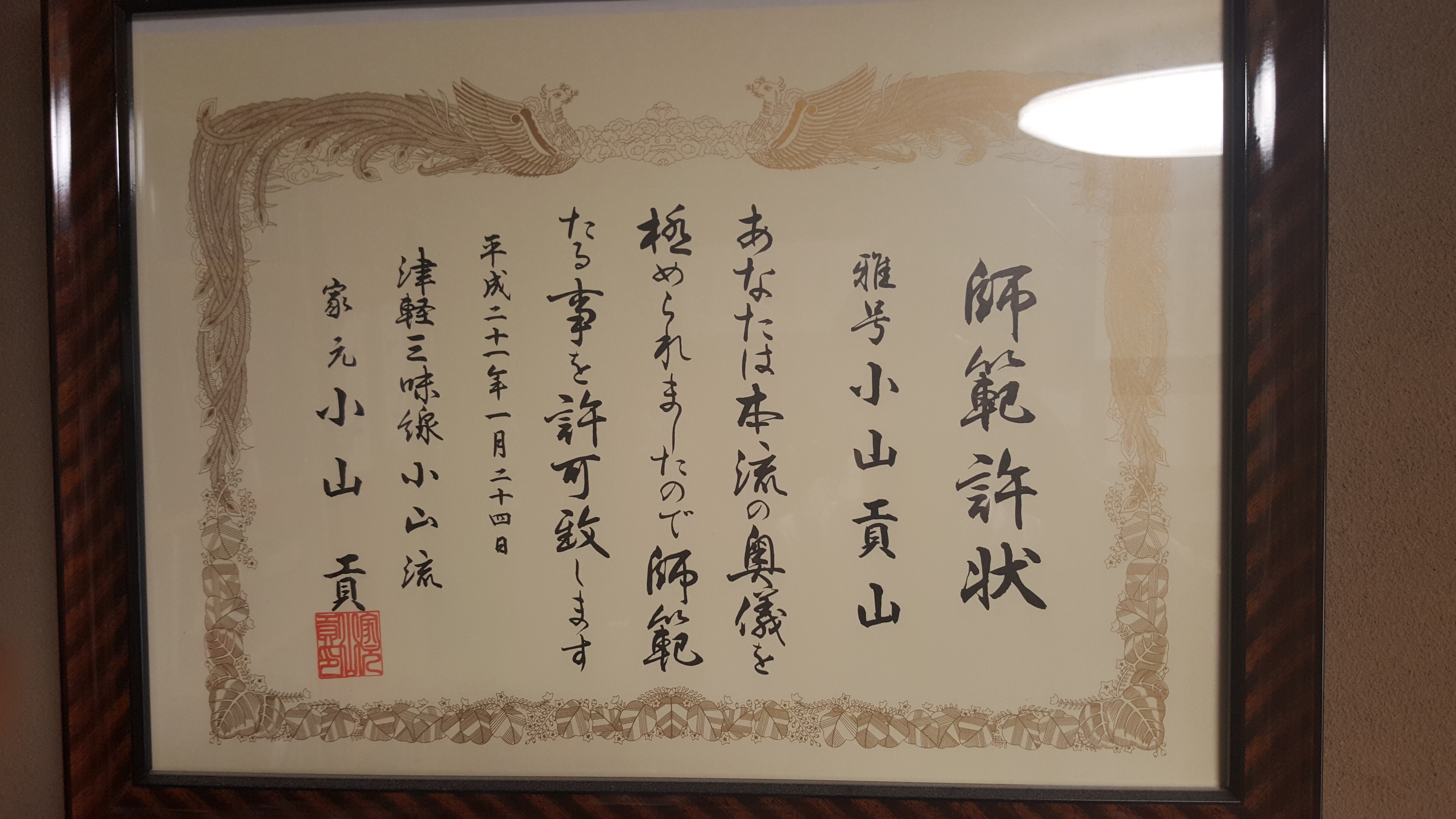
You can get a Japanese stage name (Chinese Character, Kanji ) from your master if you get master grade licence of oyama. For example, my stage name is 小山貢山. You can get 小山山○ as a stage name.
Left Certificate of teacher Right Master Grade Lisence of Oyama style.
Since 2012 01/01
Last Update
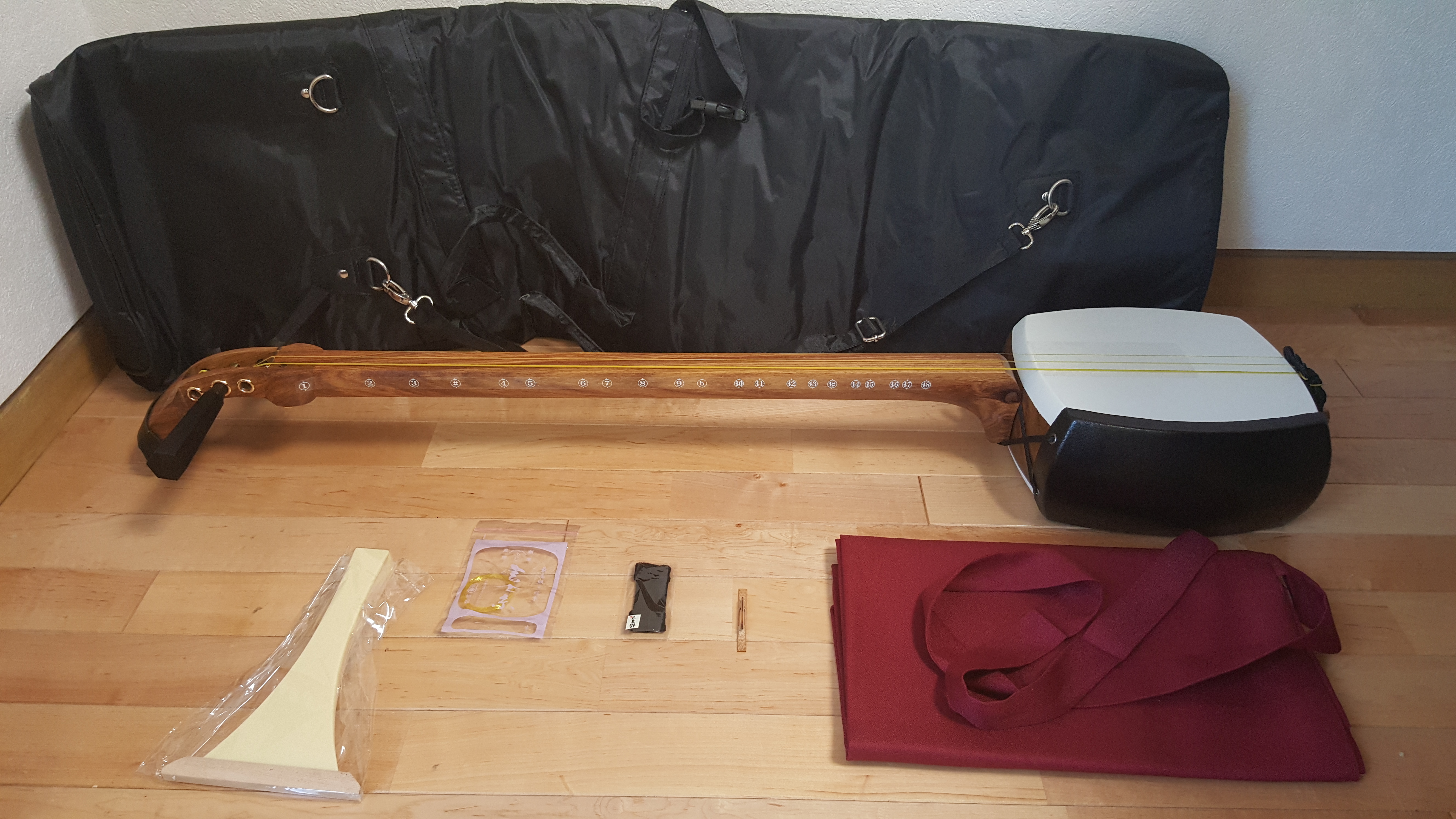
Lowest price Tsugaru-jamisen59800 JPY shipping 8900JPY(North America) Tsugaru jamisen with Azumazawari, soft case, bachi, fake skin, or other attachment you can play soon.
We accept credit card, paypal.
Shamisen review:
If you want to buy, mail to 
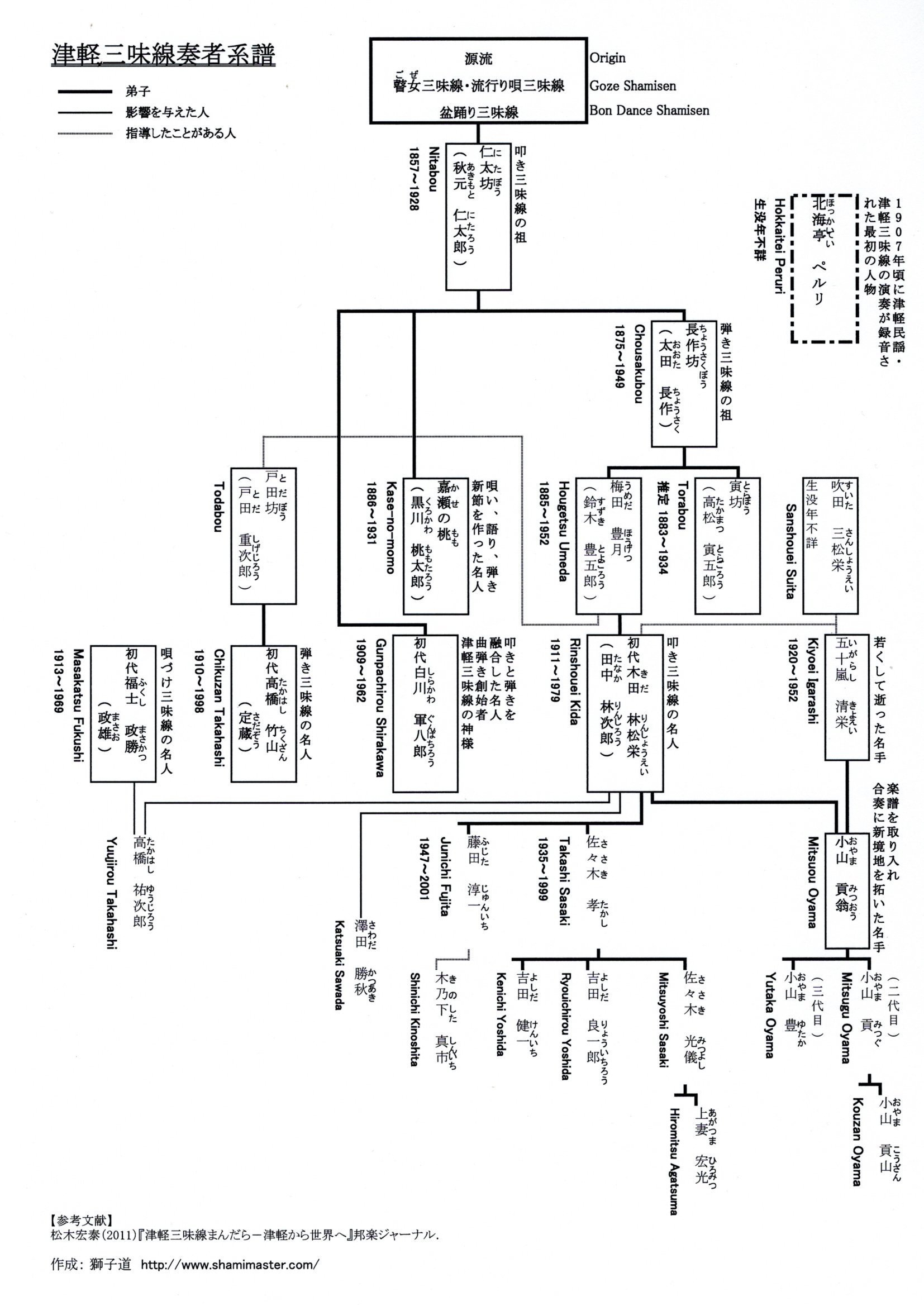
Linage of Tsugaru Shamisen to Kouzan Oyama.Head of Shishido
History Of Tsugaru Jamisen
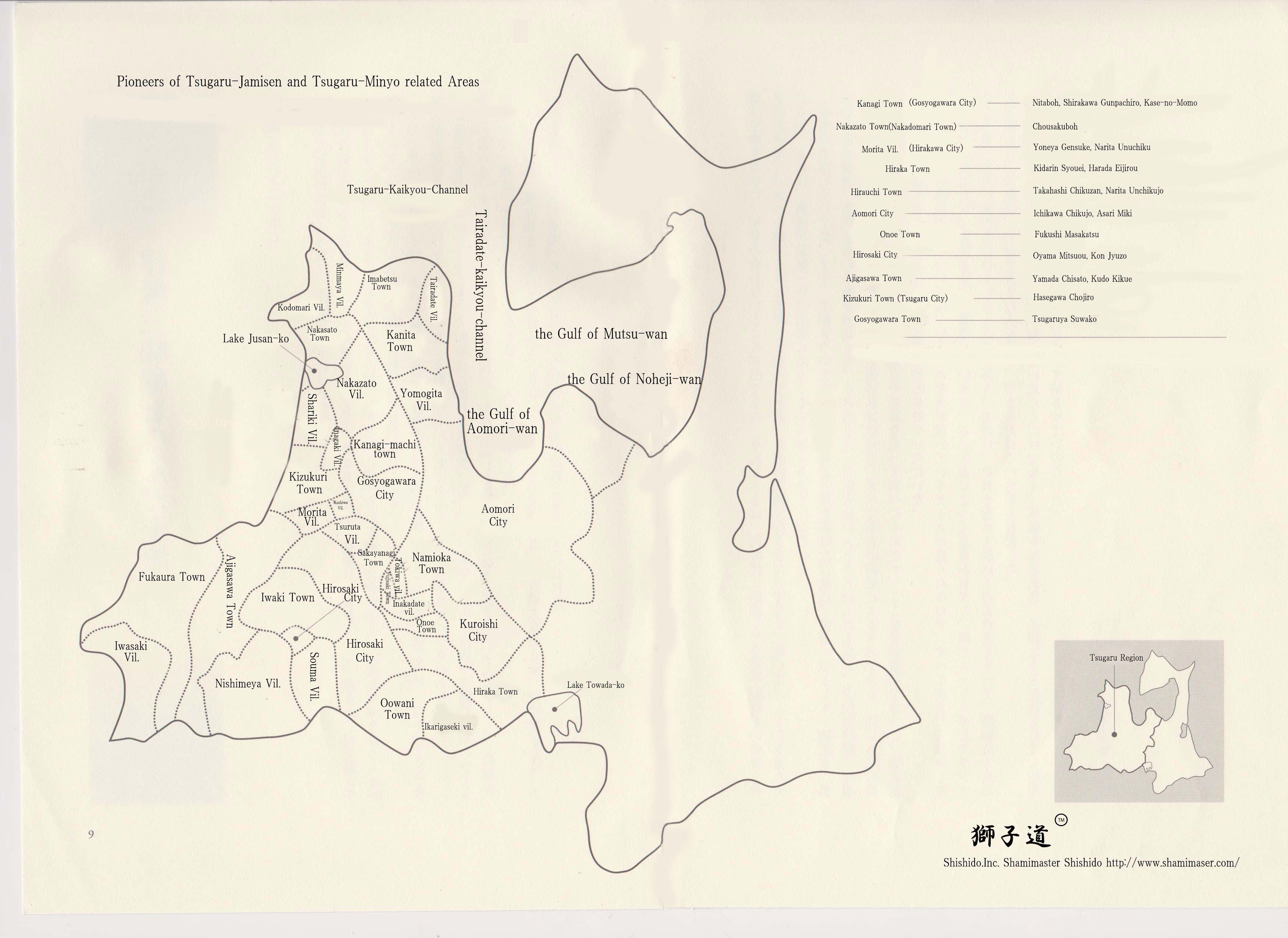
●Chapter1
●The natural features of the area where the tsugaru-jamisen was born.
●Where are the tsugaru-people from?
Before starting to talk about the tsugaru-jamisen,I want to start with the natural features of tsugaru.
Even though there was a natural border between Japanese mainland the honshu and Hokkaido,in tsugaru peninsula,there were various societies from 3000BC to 1000BC,During the Jomon period the culture represented by Sandai Maruyama(Aomori city) and Kamegaoka(Tsugaru city)prosperd,and there lived highly-
civilized people. Later, a defeated clan in a battle fled to this area.The clan appeared in 'Kozure-Ohkami,Sikaku-no-Ko
(Lone Wolf and Cub)' the comic by Kazuo Koike.After the leading character Daigoro's father,was died(Ogami-Itto) ,when he traveled around the area,
a passing man said that he was a decendant of Tsugaru-Arabaki-King.The legend says this Arabaki clan was the same as
the clan of Nagasunehiko and Abihiko who were defeated by the Yamato Court,
they fled to Tsugaru-Tosa inlet a long time ago.Before that It is said that the group from west Jin Dynasty in China lived.
The clan of Nagasunehiko and Abihiko took over the area and made the Arabaki-clan Kingdom.
Yamato Court named Arbaki-clan as 'Emishi 'clan and tried to conquer but could not.In the Emperor Saimei era,
Hirafu Abe(nobleman of Yamato Court) treated by giving Arabaki- clan a feast and gave a rank of nobleman(It appears Nihon-Syoki,the Oldest Chronicles of Japan)
The Arabaki-clan were given the name 'Abe'at that time.It means Yamato Court plecated them because
of
their overpowering strength.
This is just an aside, Prime Minister Shinzo Abe's father visted his ancestor's grave in Shiura village(Gosyogawara City at present) in which Jusan(Tosa) Lake is there.As you can see, tsugaru-area was the place where there are residents who resisted and don't obey the Yamato Court. The consiousness of rebelion and self-torture peculiar to losers may start from this era.
The mysterious thing,after that,from the Heian Era to the End of Osyu-Fujiwara culture,history was blank.The novelist Osamu Dazai
sighed in his novel'Tsugaru', What were tsugaru-people doing during over 2600 years?
He exaggerated ,but in 300 years nothing
special happened at this area.
After that Ando(Tomo Ando)clan and Kitabatake clan divided and conquered and then Nambu clan was in
control of this region. It is Tensyo(Imperial Era) 18,1590 that Tamenobu Ohura unified this region,controlling the battle among the
clan.
There are many beautiful rice paddies and skirts of Mt. Iwaki in the west and north Tsugaru where are related to how tsugaru-jamisen was born.But this area was deep marshy area ,there were some commnuities at ports and hills,so most of them were undeveloped.
For example,Kidukuri(Tsugaru City),where the author was born was named by making town by filling woods up on the marshy areas.It
is from the Edo period that a reed grown wilderness changed completely,it is because Tsugaru government started the development
of new rice paddies.In Ganroku-Era(1688-1704),the 4th governer Nobumasa developed rice paddies at the three area,Kanagi,Kidukuri,
Tawaramoto.So
people gatherd from Hokuriku area and maked many towns.The author's clan was from Echizen-Obama,but at the town
there are surname like Echigoya, Kagaya,Notoya remaining , which leaves the marks of moving from Hokuriku area.In the town where
the indigenous inhabitants and
immigrants,it produces the competitive character from fighting each other.Tsugaru-jamisen was born,in a sense from this competitive spirits expression.
Chapter2 The Tsugaru Dialect
I'll talk about Tsugaru dialect
,which is said to be one of the most difficult dialect in Japan.Famous player Michihiro Sato, who was
apprenticed to the late Master Chisato Yamada found trouble with Tsugaru Dialect that his master talked.The master said
if you don't learn tsugaru-dialect, you can't progess in your tsugaru-jamisen,but Michihiro Sato couldn't learn tsugaru-dialect,
his tsugaru-jamisen skill achieved the level that the master approve. One of the Tsugaru dialects' feature is that they use many sonants.For example, Yuki(snow) turns into Yugi,Tsuki(moon) turns into Tsugi.And then,they replaced 'i' as 'e','chi' as 'tsu' and
'Se' as 'He'
.Eki(station)turns into 'Igi' ,Tetsu(Iron) turns into Techi, Senaka(back)turns into (Henaga).The way of pronunciation is
very sutle,so Techi(Iron)
's 'chi' is kind of middle pronunciation of 'Te' and 'Tsu' Besides that,there are dialcet peculiar to Tsugaru
dialects like Azumashii(comfortable,Kimochiii in standard Japanese) Karakiji(selfish, Wagamama in standard Japanese)
This tsugaru dialects are greatly influenced by Wu-dynasty readings of Chinese Characters(Go-on),especially sonants are high
probability.When we compare Kan-on(Han-dynasty readings of Chinese characters)
and Go-on, chinese character of God, we
pronounce Shin in Kan-on , Jin in Go-on. Chinese character of eating, we pronounce Syoku in Kan-on, Jiki in Go-on.The reason
why tsugaru dialects are like this is not known,but one theory says ancient Japanese was like that,it remained in Tsugauru area,
which is the dead end of Honsyu, the mainland of Japan.
A old lady friend went to see a doctor and said about her condition of the desease'Kinagara Harayamede Nanmokene'This Tsugaru
dialects means'I have a stomacache from this morning so I can't eat any food.' 'Ke' is often used in tsugaru dialects,they say'Ke'
when they buy something,when they say 'Eat it',when they feel ichy,they
use 'Ke' in diffrent meanings.We use many omissons in
tsugaru dialect,so for example, when two people meet with each other,'Dosa'(Dokoe in standard Japanese)which means where are
you going to,'Yusa'(Sentou-e)which means I'm going to
bath house.
By the way, if we don't learn tsugaru dialect,
can't we improve our tsugaru-jamisen?I think that the answer is 'No'.
But it is sure that the tastes of dialects add to the sound of tsugaru-jamisen,I think we should just let people know about the fact.
It is because tsugaru dialects have unique rythm, and include musical factor.
Tsugaru-jamisen is derived from the accompaniment
of Minyo,traditional folk song.Tsugaru minyo singer had strong tsugaru dialects accents.
●Chapter2
●The start of tsugaru-jamisen
●Relationship with bon dance
There are many opinions about where the shamisen originated, but an established theory is that the Shamisen came from Ryukyu(An old name of Okinawa ) to the Sakai port in Osaka.Originally the Shamisen is thought to be almost similar to the present okinawan-sanshin and chinese
sanxian, except the instrument was played with one's fingernails instead of a pick.
石村検校Ishimura-Kengyo, a biwa player, (or according to some theories, Nakano Kouji) modified the instrument by increasing its size, changing the skin from snake skin to cat skin, and enabled people to play the instrument by using a bachi--which is a large pick.
As a result, the shamisen took on the characteristics of both a string instrument and a percussive instrument.
In the Genroku (元禄)-era (1688-1704), a type of Shamisen called the "Nagauta-Shamisen" appeared in Kabuki performances, which boosted the popularity of the shamisen.
Because of the instrument's portability, door-to-door singers (Kadozuke-geinin門付け芸人), singers that address to the god(Saimon-Gatari祭文語り),and blind female musicians(Goze瞽女)--who were considered lower-caste citizens at the time-- started strolling around with shamisens.
The exact time when the shamisen was introduced to the Tsugaru area is not known.
According to a history book entitled Fuunaijishitsuhien (封内事實秘苑), Hirosaki, a city in the Tsugaru area,
held it's first Kabuki performace In 1647--the third year of the Shoho Era.
One thing that is clearly represented in historical records is the Shamisen's relationship to the Bon-dance.
Before 1647, Sadahiko Hirano, a Samurai warrior from the Tsugaru living in Edo (former Tokyo),
described the traditions and customs of the Tsugaru after returning home with his Feudal Lord.
His book "Okuminzui"(奥民図彙) shows a painting of a bon-dance, and in this picture, we can see the performer who we might recognize as a shamisen player.
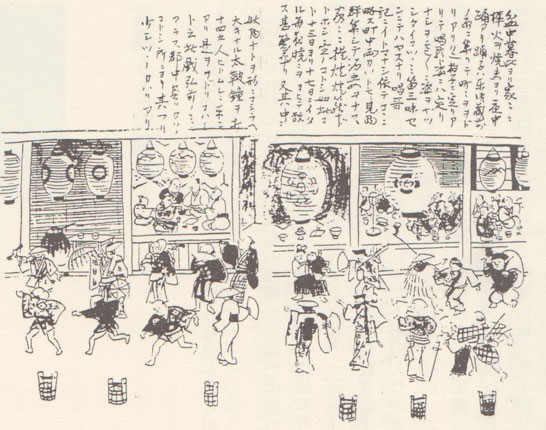
Bon-dance paint in Okuminzui
The sentence inside the picture says “People are dressing themselves as they like, accompanied by drums, flutes, and shamisen,” so it’s no doubt that shamisen was being used during Bon-Dances..But, sadly, we can’t know what songs they were accompanied by or how they played.
Even later, in 1863 (The fourth year of the Bunkyu Era) the record says that they used the shamisen as an accompaniment to the ‘Kuroishi-Yosare’ Bon-Dance.
When the wife of the feudal lord of Kuroishi went to see the cherry blossoms at a place for cherry blossom-viewing in the castle, ‘the civil people were wearing clothes freely and there were various kinds of Taiko-drums, Shamisen, and Tsutsumi drums” as depicted in the book “Kuroishi-Fundou-Kumiwakamono-nisshi黒石分銅組若者日誌(The diary of youth in the Kuroishi-Fundou group).”
That is to say, the prepared their bon dance for the cherry blossom viewing and the number of Taiko drums, Shamisen, and Tsuzumi drums were countless.It is a matter of regret that
the record has
an error in era name, Bunkyu文久 is till 3rd years, 4th year of Bunkyu(Era name) falls on the first year of 元治(Genji, Era name) If this record's mistake
is only about years,around the last days of Tokugawa Shogunate,Shamisens accompany Bon-dance in Kuroishi,but we don't know how to accompany.
When we talk about the tsugaru shamisen's history, only the relationship to bosama 坊さま, blind itinerant shamisen players, is highlighted, but it is also related to bon-dance and has a grounding as accompaniment for its songs.
In Edo era, there was a status system, 士農工商 Shi-No-Ko-syo, like the classes of warriors, farmers, artisans and tradesmen.Under the grade, there was lawly grade,
In tsugaru ,they designated a part of them as 7 beggers. Syukke stading at the door ,出家(A kind of priest), Syugen修験(a monk who leads an ascetic life in the mountains) at the door, komuso 虚無僧(the priest who plays shakuhachi), Zato-no-Boh(A person of the group of the blind people),Rokubu(A kind of priest) Ronin( A masterless samurai) at the door and an actor or actress.One of them, Zato-no-Boh is Bosama, who is a blind begger.
In Edo era, when blind people become 15 years old, they were supposed to join the group'Toudou-Za(当道座)'which is the group of blind people.
The grade of blind people is from above, Kengyo検校,Betto,別当、Koutou,勾当,Zatou,座頭.Even among the lower grade Zatou,there was a grade system,so in order to
get higher grade,they required status and money.In this point, Zato-no-Boh,Bosama was the people who dropped out from the system.
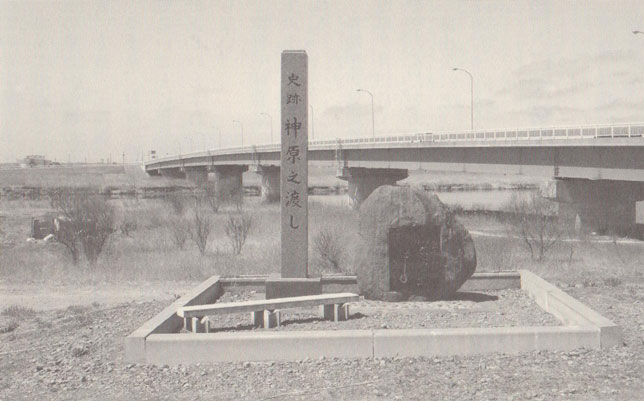
Photo:A monument of Kanbara-no-Watashi(small ferry port) and Nitaboh
However, Toudo-za is an organization recognized officially by Bakufu,the goverment at the time,which rules Biwa,Sokyoku(koto) and Sangen(different name of shamisen) recognized as official arts, Anma(Japanese type of massage) Hari(Acupuncture) and Kyu(Moxibustion) ,recognized as not oficiall arts. So Bosama can't disobey it.
Meanwhile,the local goverment Han observed Bosama, the people who came from bad family, carefully.It is because the goverment kept eyes on spy from mortal enemy Nambu-
Han(Goverment) or Bakufu (Japanese main feudal goverment at the time)
This kind of situation like a spell finished at the time of Meiji Restoration,Bosama were free from a grade system.But when they became ordinary people
and were allowed to have a family name, the situation that soulder begger's debts,and were discriminated was not changed. In tsugaru area,beggers are called
'Hoido',Even Takahashi Chikuzan was called 'Hoido' when he did Kadoduke, begging on street corners.
Bosamas who became free by the demolition of Toudouza and collapse of Han,feudal goverment, did Kadoduke with shamisen and shakuhachi.
Among them,
a man who got good reputation appeared.He is Nitabou(仁太坊、Real name is 秋元仁太郎(Akimoto Nitarou)),who are said to be the
founder of tsugaru-jamisen.
Nitaboh was born as an only son of Mori Santaro,(森三太郎) a ferryman of Iwaki-gawa River, at Kambara-Mura (神原村)
(the present Gosyogawara City 五所川原市
)village, of
Kanagi-Shiden(金木新田)on July 7th in 1857.He was loved by villigiers or passengers of his
father's ship, because he is
good at Minyo since he was a child,and his telling stories was so good ,so it put adults to shame. When he was at 8 years old,
he sufferd from smallpox, and he survived miraculously,but he got blind. The pockmarked face became his trademark in his lifetime.
There are various theories about from whom he learn shamisen.But the theory in common say it is female blind shamisen player . The late Shirakawa Kengoro
(白川兼五郎) says the old man at the village said Nitaboh learned shamisen from a female blind shamisen playe , Goze, r who came from Oosaka area to Jusan-Minato.
Mr. Shirakawa says in KanagiKonjakuMongagari(金木今昔物語)
Santaro(三太郎) the father of the boy asked Goze couple and got permission to learn shamisen.
The boy was 10 years old at that time.The boy made very beutiful sound which surprised Goze. He listened the story from Kametarou Suzuki 鈴木亀太郎 dubbed
Onbe(Village Oracle ) It's trustworthy because it's the memory of village oracle.But there was no record that goze came to tsugaru.
I put up the map of an old name of tsugaru peninsula
facing the sea of japan,
The Flow of Tsugaru Minyo
1,Kase-No-Momo and Tanesato-no-Matsu and Desaki-no-Boh
Speaking of Tsugaru minyo, it
reminds us of Jongara-bushi.
Jongara bushi has various types of melody, lyrics are short and intersting, and nothing is more touching the people in tsugaru heartstirings and moving than this song.
The reason why tanesato-no-matsu is less famous today compared to Kase-no-Momo , is that Matsutaro only stolled around his local County, Nishi-gun(West Couty) and Kita-Gun(North Couty) meanwhile Momo strolled around all area of the tsugaru as the professional.
Jonkara bushi is difficult,and people often say ,if you master the melody, you can sing any other songs.
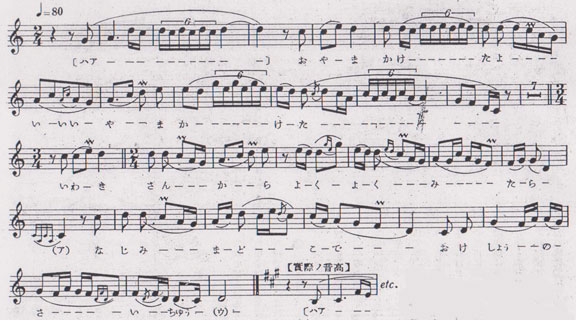
The score(western notation) of jongara shin-bush
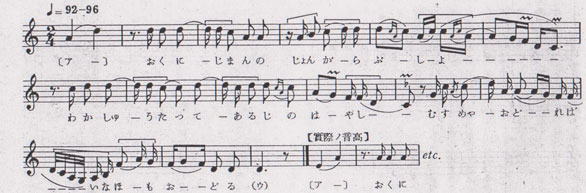
The score(western notation )of jongara naka-bushi
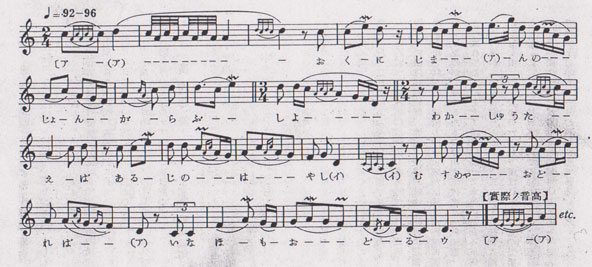
The score(western notation )of jongara Shinbushi
Some people asks the means of 'Jongara', most famous song in tsugaru-jamisen repatoire.
It's from place of name, Jougawara, at Aseishi in Kuroishi in Aomori Prefecture.
...
Jougawara is at upper stream of Aseishi river.
Johen, a buddist priest prosecuted by Tsugaru Tamenobu, feudal lord at the area
at that time drowned by himself, they started singing Jongara-bushi for his soul.
That's the origin of Jongara-bushi.

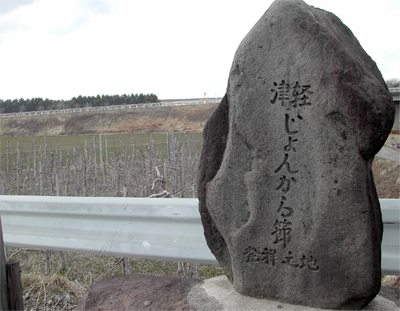
This is a monument of birth place of Jongara,
Saying 'Birthplace of Jongara'
It is situated on the foot of Joukawara Bridge, which is the origin of the the song 'Jongara'?
Map
http://kuroishi.or.jp/ sightseeing/jyonkara-place
His Ideas for Tsugaru-shamisen
Originally speaking, Tsugaru-shamisen had been just regarded as the accompaniment of Tsugaru folk songs. After Gunpachiro Shirakawa established the new playing style of Tsugaru-shamisen, “Kyokubiki”(playing ad libitum), it has been seen as new genre of Japanese music. He was not as popular as Chikuzan Takahashi in Japan because of his short life, but he has been called “the God of Tsugaru-shamisen” in his birthplace, Aomori prefecture.
In 1909, on January 23th, Gunpachiro Shirakawa was born in Kanagi, as the son of farmer’s house. He went blind when he was 4 years old due to measles. Even though he had slight eyesight but there were no choices for him but to live as blind person. His parents worried about the son’s future, so they decided to get him to learn how to play instruments for his living; they asked Nitaboh, who was the first Tsugaru-shamisen player and lived near his house, in order to teach him.
Nitaboh taught Gunpachiro how to play Shamisen, Shakuhachi, and Yokobue(Japanese flute), and the maestro was deeply impressed by his talented sense of music. Gunpachiro was the last Nitaboh’s student and it was said that the little boy’s skill exceeded his maestro’s in just 3 years. During his lessons they performed the shamisen on the street and festivals in Kanagi for busking.
For example, they earned the most at the festival in Kawakura, which is famous for the ritual performances of Itako; Japanese female shaman who have the ability to communicate with the dead. In this festival, there are so many food stalls and playing booths, street live performances of fabulous shamisen players, and people weeping over communication with the late relatives by Itako’s channeling. These events produced the atmosphere that not only ordinary people but also the dead can join the festival to have and share various emotions together. Gunpachiro performed the shamisen a lot with his maestro, and these experiences were the basis of the playing style of kyokubiki.
After 3 years lesson, Gunpachiro came to be interested in the other playing style of shamisens (such as Nagatoro-de and Umeda-de). He practiced the shamisen all day long on the roof of his house and acquired them by himself. In 1924, when he was 16 years old, He was invited to join “Owara-ke Manjiro Ichiza”, which has even been noble Japanese dancing troupe in Tokyo today. In this group, he also learned the other playing style such as Kappore, Yasuki-bushi, and Tsugaru-teodori.
2 years later, the chairman, Manjiro passed on his position to his little sister, Tsuruko Mikami. Since then, Tsugaru folk singers, especially female ones (Mie Kudo, Kuniko Kansei etc.) started making new troupes and touring around Japan.
During the increase of the number of ichiza(music troupe), many people tried to recruit Gunpachiro as the exclusive shamisen player in a certain ichiza for his distinguished talent of music and enthusiasm for practice. But he declined all of their initations because he has also indifference toward money..
This site is the tsugaru-jamisen learner by yourself.
Professional tsugarujamisen players often say tsugaru-shamisen, because among shamisen players we call it shamisen.
But the tsugarujamisen is correct as Japapese, and most Japanese say tsugaru jamisen, so I synthesize "tsugarujamisen"
of this site.
You can learn shamisen for FREE!
I have class in tokyo/NYC(Once a year around August 15th)
So contact me freely.
skype name shamimaster
Tsugaru jongara bushi , most traditonal style movie
I would like to begin my discussion of the Tsugaru-jamisen with a brief
description of its history. The first person attributed with being a
Tsugaruru shamisen musician was a blind performer named Nitaboh, who is
credited with inventing the revolutionary shamisen technique during the
Meiji Era. Nitaboh was a monk or “Bosama,” who in order to survive
practiced “Kadouke” or begging on street corners as well as playing the
shamisen door to door to collect donations. He was subject to some
discrimination because of his begging practices.
Located at the northern tip of Japanese mainland, Honshu, Tsugaru is the
former name of Aomori Prefecture. Famous for its bitterly cold winter
weather and rough seas, Tsugaru is the birthplace of the “Futozao” or
thick-neck shamisen which first originated as the accompaniment for “Minyo,”
or the traditional folk songs of the workers.
The Tsugaru-shamisen soon evolved into an instrument which was used to
perform with independent from the songs of “Minyo” and with time changed
into the style we call "kyokubiki" or freestyle acrobatic techniques.
Types of Shamisen
There are many kinds of shamisen being used in Japan. These range from the snake-skinned jamisen of Okinawa to the thin necked cat-skin naga-uta shamisen to the thick neck dog-skin Tsugaru shamisen.
The thicker the neck of the shamisen, the greater the volume the drum provides. Thus Tsugaru shamisen gives the loudest sound of all shamisen types.
Historical background
The reason why the Tsugaru Shamisen is struck so hard with the Batchi is because in the old days there were no microphones so in order to be heard above the noise of the crowd the shamisen was beaten heavily with the Batchi.
1. Shamisen parts
The thickest string of the shamisen is called "Ichi-no-ito" or "Bottom String" literally means first string
The second or middle string of the shamisen is called "Ni-no-ito" or "Middle String"second string
The third and thinnest string of the shamisen is called "San-no-ito" or "Top String"Third string
2. Holding the Shamisen
To begin with, rest the drum's edge on top of your right upper thigh and rest the drum at a 30 degree angle against your abdomen. Allow your right arm to rest comafortably on top of the drum.
You should be able to hold the shamisen using only your right hand, suppressing the instrument against your body and allowing your left hand to be completely free.
The angle of the shamisen's neck should be 45 degrees for the Tsugaru which is greater than other kinds of shamisen. This angle allows you to move your hand more easily and rapidly.
3. Holding the "Batchi" or "Plectrum"
Functioning like the pick of a guitar, the Batchi is a critical element when playing the shamisen. Correct Batchi handling creates a much more beautiful sound.
There are many types of shamisen in Japan,Tsugaru-shamisen uses a thicker neck than nagauta-shamisen in kabuki.
This is because the thicker the neck becomes, the bigger the body becomes,and it can make a louder sound.
First you hold the top of the plectrum vertically with your left hand,
then open your right hand with the ring finger folding.
The point is the dent of the little finger (pinky) knuckle.
The handle of the plectrum should rest between the pinky knuckle. Your pinky should remain folded and bent upwards as shown.
.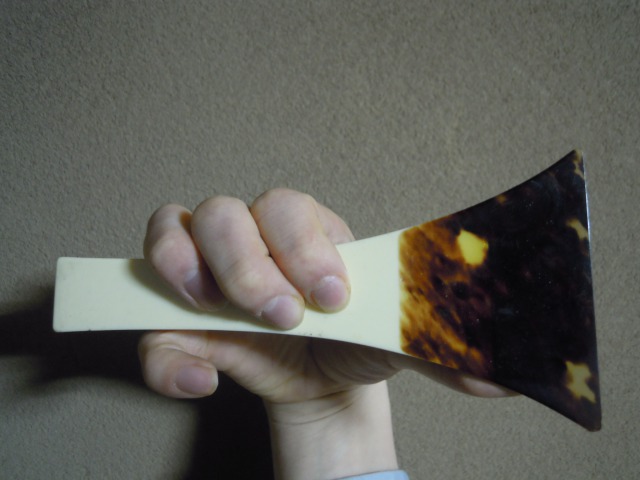
picture1: good example of a correct grip
While keeping a dent in the knuckle of pinky,
bend your right wrist 90 degrees, put the grip of the plectrum between middle finger and pinky and hold the grip with your ring, middle,
index finger and put your thumb on the side of plectrum with your thumb half outside the edge.
The tip of your thumb is 1 cm away from the tip of the plectrum. Next , bend your wrist at a 90 degree angle, waving it like fan.
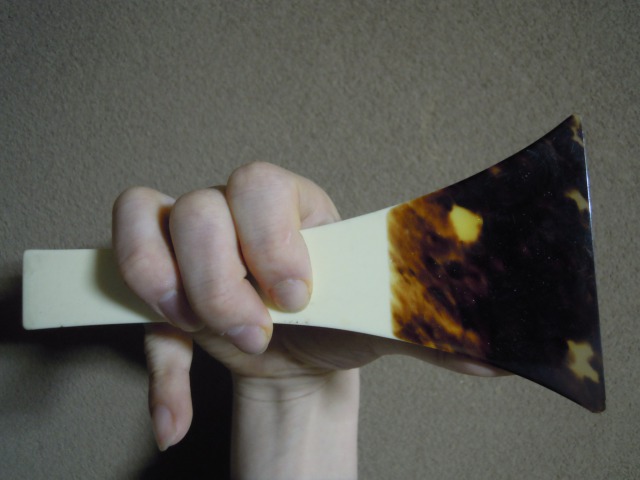
picture2;bad example
with your thumb half outside the edge.
The tip of your thumb is 1 cm away from the tip of the plectrum.
Next , bend your wrist at a 90 degree angle, waving it like fan.
3. Tuning
When tuning the shamisen always begin with the the first string or "Ichi-no-ito". This string is tuned to C.
The second string is then tuned to G and the third string to C. This tuning is known as "Ni Agari".
To know if the strings are correctly tuned, press down at the 6th fret or Tsubo on the first string and pluck it. The pitch should be the same as the second open string. In the same way, press the 4th fret or Tsubo on the second string and pluck. This pitch should be the same as the 3rd open string.
The original tuning of shamisen is CFC, called hon choshi. Compared to Honchoshi, Middle string is raised, so we call it Niagari.
(Agari means raise )
Honchoshi is used as tsugaru-ohara bushi ,akita nikata bushi.
While we have one more tuning called sansagari. It's CFBflat,compared to original tuning, the top string is lowered, so
we call it "San Sagari" (Sagari means lower)
4. Reading the Score
Jongara Kyuubushi(Oyama style ) The jongara(basic type ) score (Compartive of Both Western Notation and Shamisen Tab Score )
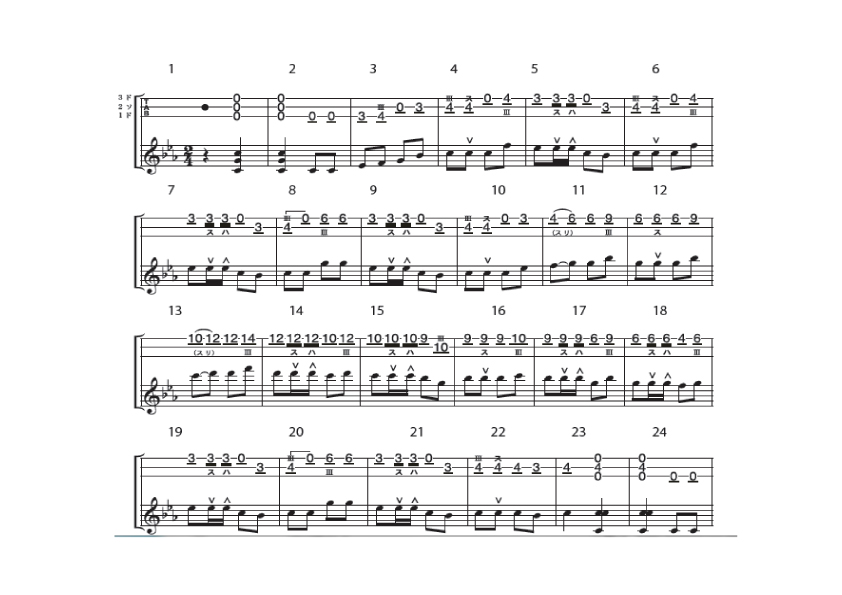
It is necessary to know how toread the score in order to practice shamisen alone.
The score, known as Bunkafu has 2 lines which correspond to the 3 strings of the instrument.
The uppermost lines corresponds to the 3rd string, San-no-ito. The middle line indicates the second string (Ni-no-ito,), and the lower line indicates the first string (Ichi-no-ito or thickest string).
The lines under the numbers indicate the length of the notes, no line under the number indicates a quarter note
one line under the numbers indicates an eighth note, a double line under the number indicates a 16th note.
Picture3:Notes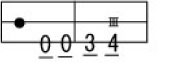
Therefore, by adding a line under the number the length of the note becomes half.
A black point means "rest", 0 means to play an open string, and all other numbers correspond to the number of the fret.
pluck each number while pressing down on the corresponding frets.
ス means upstroke,ハ
  means pluck,3ハmeans pluck while pressing the 3rd fret.
スリmeans sliding. 4-6スリ means after picking at the 4th fret ,slide your left finger to the 6th fret ,without playing 6.
The marks like parenthesis means Oshibachi,or to press the higher string first and then drop down to the
desired string without playing them simultaneously.
This type of score is called bunkafu,literally means cultural score.
The fret one octave above is 10.One active have 12 chromatic , so add # sharp and bflat fret,
0 1 2 3 # 4 5 6 7 8 9 b 10 11 12 13 1# 14 15 16 17 18 19 20.
In Japanse musice, one octave consist of only 5 notes, pentatonic.
We say it Yona nuki Onkai(Scale)it means skip Yo(4th note,Fa) Na(6th Note So)Do Re Mi So Ra Do.
If you improvise with the rythm with stroke , upstroke, stroke, stroke, and using this pentatonic scale,
We call it JonagaraBushi.
Compared to it, Stroke, Upstroke , Stroke with the Scale, we call it Yosarebushi.
The orbit of the upstroke Movie
shamisen score site
Jogara kyubushi Movie
5 Techniques
Kamkimawashi (kamashi, kamashi)
literally means "roll" The most charasteristic technique of tsugaru-shamisen.
First pick the open string, while press the 3rd fret with index finger, pluck with ring finger and then
pluck index finger which is pressing the 3rd fret.
Next upstroke open string, place 3 with the index finger, pluck with ring finger and then
pluck index finger which has placed 3 .
It is important not to pluck strongly.
5.How to change strings
movie
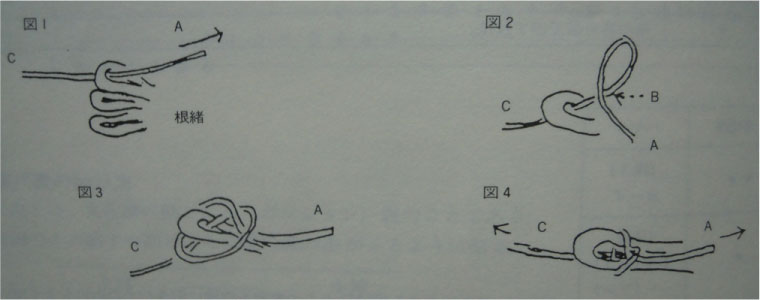
The general number of string set
Bottom-25
Middle -15
Top - 13
Of course thicker string makes louder sound, but it get hard to hit correctly.
Pro uses 30 bottom string.
Bottom string is only made from silk,
Middle is tetron(kind of nylon, plastic ) ,nylon or silk.
Ofcourse silk makes better sound , but easy to break, so for begginer I reccommend nylon.
Bottom string is only nylon(in chikuzan-style we use silk)
6,The songs
Three major Minyo
Jongara-bushi
Lyrics
Haaaa Okuni Jiman No Jonkara bushi yo
Wakai Syu Utaeba Aruji No Hayashi
Musume Odoreba Inaho MO Odoru
(Jongara Bushi, the pride of our homeland
When the young men sing to the chants of their master,
Shoots of rice dance when
girls dance
)
Hahhh Tsugaru Yoitoko Oira no Kuni Yo
Mizu ga Kirei de Onnna ga Yokute Koe ga
Jiman No Jongara Fushi Yo
(Tsugaru is beautiful area, my home town.
Water is clear and girls and nice and beautiful ,
We are so pround of voice singing Jongara bushi
)
Youtube Movie of tsugaru jongara bushi song, sang by 54th champion of tsugaru minyo ,'tsugaru minyo singer kasumi'
Yosare-bushi
Hahh Chooshi Gawari No Yosare Bushi Yo (The feel of Yosarebushi is different from other Tsugaru folk songs. )
Hahh Tsugaru Yoitoko Oira no Kuniyo(Tsugaru is a good area and this is my country)
Hahh
Haru ha Sakura NO Hirosaki Ni Sakazuki Katate NI Ngamureba Kasumi Ni Ukabu Tsugaru Fuji
(In the springtime, sakura season in Hirosaki. while drinking sake you gaze past your cup and see Mt. Tsugaru-Fuji above the clouds )
Hahh Natsu wa Soyokaze Namishizuka Ohtose Fukaura Asamushi Ya Nakademo Kiwadatsu Towadako Ya
In the summertime, breeze and gentle waves. Odose, Fukaura, Asamushi, and especially the lake of Towada.
Hahh Kuroishi-zai wa Akinosora
Ohara-bushi
Hahh Dashitaga Yoina
Hahh Oyama Haretayo Asagiri Hareta Susono no kikyou no hanazakari
(It's fine and no morning mist on mountain ,Bell flower comes out on the skirt of Mountain)
+
Aiya-bushi
Hahh Aiya--na--
Aiya uta ga kikoeru(nagareru) Okuni no Uta (You can listen to Aiya,tsugaru song.)
Yosare Jongara Soremo Yoiya Aiya bushi (I also like yosare, jongara other than aiya bushi)
Sansagari
We say Five major minyo.
Other songs.
Ringo-bushi(apple song)Movie
lyrics
Haru wa Ringo No Ito Hanazakariyo
Itoshi Otome No Yohoe
Eh Hohkamuriyo
(Apple blossom bloom in the spiring
Lovely Girls with their face partilly coverd with a kerchif
)
Natsu wa Aoba No Midori No Hayashi Yo
Mitsu Ni Akogare Yohoe
Eh Mau choucho
(Green Leaves come out in woods in summer
Butterflys flies dreaming honey
)
Tosa no sunayama nah eh Kome Nara Yokarona
(I wish that that sand dune at tosa shore were rice.)
Nishi no Benzaisyu Nyah ah ah eh Uh uh uh uh
(Benzaisyu,traders from the west)
Nishi no Benzaisyu Uh Uh e
Tada tsumasyo tada tsumasyo
(They replied that they could ship sand dunes for free.)
Kuroishi Yosare bushi
kuroishi yosare bushi doko demo hayaru
(kuroishi yosare song is popular everywhere)
Mashite kuroishi Hayaru Yosare Sa
(Morover kuroishi(place) become populer it's yosare in kuroishi)
Yasaburo bushi
Hitotsu a eh Kizukuri Shinden No Shimo Aino
(First, at shimo aino in kizukuri shinden, on the outskirts of the town, there lived Yasaburo.)
Futatsua eh Futari to San nin to hito tanonde obiraki no mankuro kara Yome Morata
(Second, Yasaburo's parents asked a few people to marry a woman from Mankuro , in Obiraki)
Mitsua eh Mitsumono Soroete Morata Yome Morate Mita Toko Kini Kuwane
(Third, despite preparing a great trousseau for his marriage, he didn't get along with her.)
Yotsua eh Yokusa Asakusa Kakane domo osoku modoreba ibirareru
(Fourth, she never missed weeding in the morning and night, if she came home late, she was scolded.)
Itsua eh Ibirare Hajikare Niramerare Hi ni Sando no Kuchi Tsumoru
(Fifth, she was bullied, left out of the family, given angry looks, she was not given a meal three times a day.(taught by kasumi))
Mutsua eh Muri Na Oyasyu Ni Tsukawarete Toh No Yubiko Kara Chiko Nagasu
(Sixth, forced to over work, she bled from her ten fingers
Nanatsua eh Nambo Kaseidemo Hataraitemo Tsukeru Aburako mo Tsukesasene
(Seventh, though she worked hard, eager to earn money, they force her not to use hair oil.)
Tsugaru Yosare Bushi
Hah Choushi Gawari No Yosare Bushi Yo ,Yosare Sora Yoiya
(I'll sing Yosarebushi of the irregular beats..)
Hah Tsugaru Yoitoko Oirano Kuniyo
(Tsugaru area is a good place ,my home town)
Hah Haru Wa Sakura No Hirosaki Ni
(At Hirosaki , where is famous for Sakura in spring)
Sakazuki Katate Ni Nagamureba
(When we see far away with holding a cup of sake)
Kasumi Ni Ukabu Tsugauru Fuji
(we can see the Mt. Tsugaru Fuji above haze.)
Hah Natsu Wa Soyokaze Namishizuka
(There is gentle breeze and calm wave in Summer)
Ohdose Fukaura Asamushi Ya Nakani Kiwadatsu Towadako,
(Points of interests are Ohdose , Fukaura, and Asamushi(location name )and Towadako lake is famous among them.)
Hah Kuroishizai Ha Aki No Koro,
(At Kuroishi, a countryside of Tsugaru Area ,in autumn)
Tsuzuku Tambo No Benizono Ni Nagaruru Otomeno Kuni No Uta
(A folksongs are sung at a series of apple farm, colered with red.)
Migi Mo Hidari Mo Yosare Bushi , Yosare Sora Yoiya
(Yosarebushis were sung everywhere.)
●Modern Songs
Kakusei(disillusion) Movie It's the modern song played by hayate
using harmony
Kodo(Beating) Movie
You can buy the scores of the song above at http://www.shamimaster.com/gakufu.html
Contact shishido shamimaster.com(put into @ )
The scale of tsugaru jamisen
Japanese music mostly consists of pentatonic, The most major tsugaru minyo jongara bushi consist of
Ra Do Re MI So RA, we say Yona nuki scake because YO,4th and Na 7th is skipped.
And if you improvise with the scale and rythm of stroke(weak) ,ustroke (weak),stroke(strong)stroke(strong)2-4time,
We call it jonagararbushi,
Compared to it , 3 -4beat with the scale is Yosarebushi,
with Honchoshi tuning and 3- 4 beat, we call it Oharabushi.
Aiya bushi has two types , major scale type and minor scale type. Original aiyabushi is minor scale type,
but it change into major type to appeal the audience more,
And The major scale with 3-4 time rythm with sansagari tuning, is sansagari.
All finishes with kakimawashi(roll).
7. Advanced techniques
Mae bachi(front bachi ) and Ushirobachi(back bachi)
We hit 2part of body, front and back.
when we hit front, the pinky is on the bridge ,when we hit back, the pinky touches neo, music knots.
When we hit first string, we only hit back bachi. When we hit middle string and the thinnest string, we hit front of the body
and back of the body alternately.
It's the most distinctive feature of tsugaru-shamisen compared to other types of shamisen.
Other types of shamisen only hit front of the body.
It's because by strong beat in back bachi and weak beat in front bach, it makes clear rythm.
In Jongara fushi, it's 4 times beat of stroke, upstroke, stroke, stroke, first two notes(stroke, upstroke) is front bachi
and stroke ,stroke is back bachi.
Neumi(clarify the sound) it means playing notes pianissimo. To create this sound it requires high skill, we put right little
finger on the right side of koma brige and muffle the tone.
The western notation of score
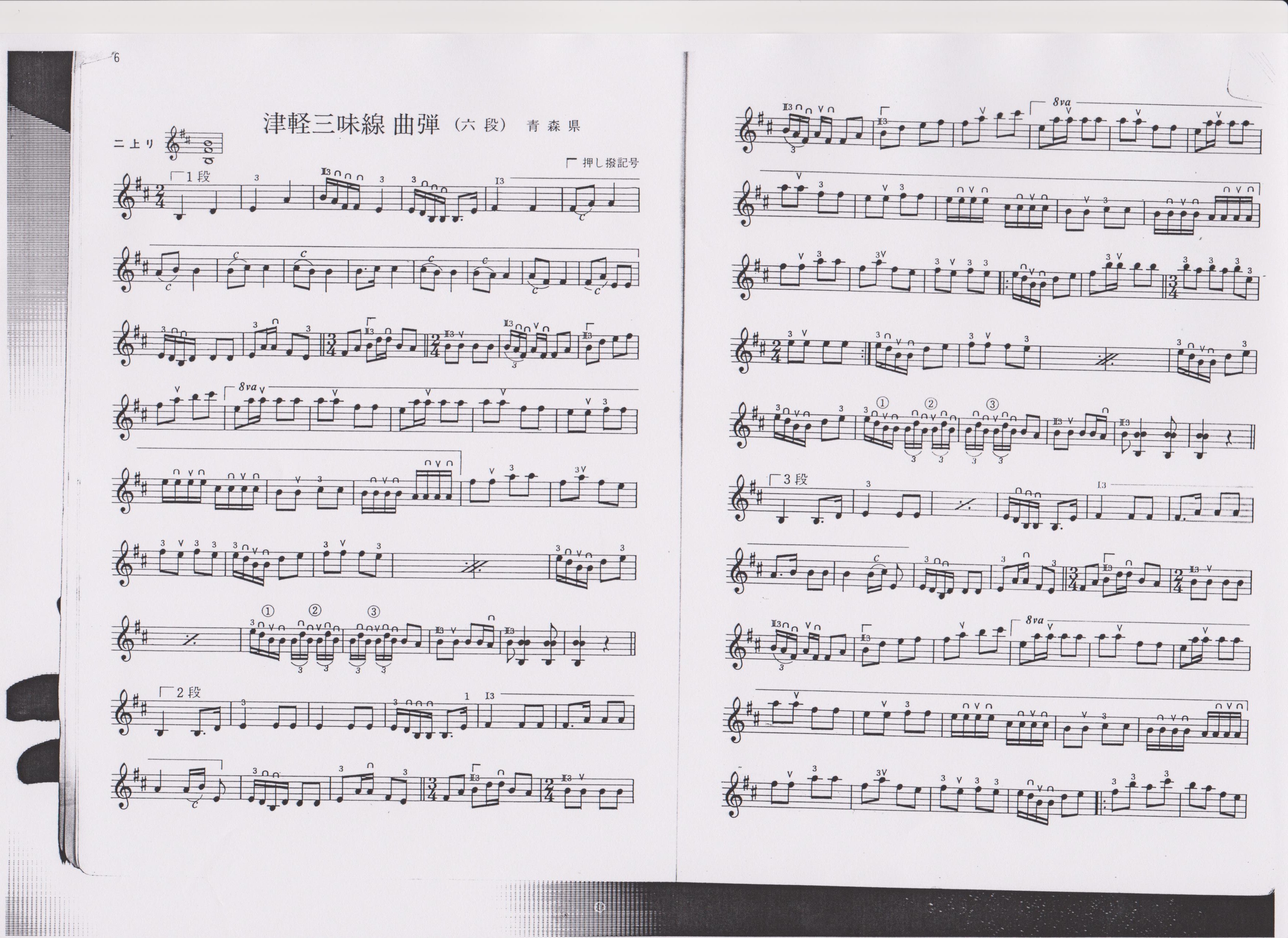
Jongara bushi rokudan. Score
Rising Score
About National Tournament of tsugarujamisen
Hirosaki tounament is oldest,
honarable tournament.
Founded by Chisato Yamada,
Kinoshita Shinichi and Agatuma Hiromitsu got the championship
Kanagi tournament is the seceond oldest ,founded by tsugarujamisen history researcher Dajo kazuo.
It is said to get award easier than Hirosaki.
Hibiya, tokyo tournament is the one of the highest tournament, Yoshida kenichi, the younger brother
of Yoshida brothers got the championship.
Oosaka tournament is noted by the quick play.
Other tournament is held at
Aomori
Nagoya
Osaka
Kyusyu
Kagawa
kuroishi
History of sawari
The shamisen was first introduced to Japan during 15th century.
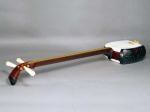
The shamisen has a mechanism for purposely making a buzzing noise.
The buzzing sound is made by keeping the bottom string off the nut,so it touches the edge of the depression under the nut.
This is a distinctive feature because western instruments are developed to reduce noise,
so it's the opposite way of thinking.
Now we have a mechanism called Aduma Sawari (literally means west Sawari).
The mechanism makes a buzzing sound by raising and lowering
a piece of wood on the fingerboard with a screw at the other side of neck.
We adjust the aduma sawari to make a buzzing sound that will last as long as possible.
Unlike normal sawari, aduma sawari makes it easier to creat the buzzing sound
even when the tension of the strings changes,
so we don't need to keep the bottom string off the nut.
The depression under the nut has no use but it remains only a shape.
In ancient times without aduma sawari it was difficult to create the sawari sound.
So shamisen players did things such as putting tiny layers of japanese paper (washi) under the string or
crushing a string by pushing it strongly.
This mechanism is not attached to the okinawan sanshin.
Shamisen is said to have developed from the okinawan sanshin.
We wonder when sawari was put on the shamisen.
When the shamisen was first introduced to the Japanese mainland,
all strings were on the nut, but
around 1630, we can see a picture in which a shamisen's bottom string was off the nut, but all strings are on the nut when we see a shamisen made during the same period, so we can see that both ways exsited during this period.
But the textbook for learning shamisen by oneself around 1760 says that the bottom string
was off the nut, and explains it.
So we can conclude that around 1760 the sawari mechanism was a standard part of the shamisen.
Cited from this book
To Enrich the content of this site, please buy something from the link above. We need YOUR help.
I offer skype lesson 45minutes/4000 JPY We accept paypal.
How to get shamisen
It's hardest point to start shamisen.
The new cheapest shamisen cost 56000 yen( plastic skin, plastic batchi) JPY without shipping.
If you can read Japanese , Yahoo Auction is also better choice.
The cheapest shamisen neck is made from Karin,
The middle
class neck is made from shitan,
The highest class neck is made from Kouki, the heavy wood it can sink in water.
As above, shamisen grade depends on the neck.
Of course the sound is clear, but the other important reason is that the surface of the neck wear down
by friction of the finger, it leads to noise.
Kouki wood is litterally means Read Wood, the shamisen of this neck cost at least 200thounsand JPY.
Hi end shamisen is around 1 million JPY, more than it, the worth depends on artistic worth, such as wood pattern.
Tourtle shell
We use Bekkou, tourtle shell as batch, import and export is prohibited by the Washinton Convention.
It is said we use only the tourtle shell before banning by the Washinton Convention,
But the price didn't get higer like ivory,so I think import from somewhere.
We have a aqua cultured tourtle shell,but the bekkou craftman said it's not good for batchi.
Bekkou bachi is from around 20thousand JPY.
String
The link below is the website making the traditional instruments in japan
including koto, okinawan sanshin.
http://www.marusan-hashimoto.com/qanda/index.html
Shamisen stirng is made from silk originally,
But now in tsugarushamisen mostly used nylon for top string
... so it's easy to break.
In nagauta shamisen and jiuta shamisen we still uses silk as a top string,
the sound is more clear than one of nylon.
Takahashi chikuzan used silk string as a top one,
so now even tsugarujamisen chikuzan style play still uses silk sometimes.
The reason why shamisen's string is yellow is the remains
we use tarmelic as perservative,
One of my students said,
"You can see strings when strings are white because body is white."
My student was totally correct. lol
http://www.shamimaster.com/tsugarujamisen.html
The way of knotting strings of my hakama,traditional skirt like pants's is differnt from usual,I usually tie with cross s...haped because only samurai used cross knots. It's called entertainers' way of tie because bridegroom and bride is the protagonists of the ceremony. Tsugaru aiya bushi cotains lyrics of wedding ceremony, so I sang it.
Tourtle shell's batchi is flexible, but nowadays we have fake bekkou batchi called Neo Bekko.
It's around 20thousand JPY, not so different from real one.
Contact:

facebook
http://www.facebook.com/#!/shamimaster.toshi
Bachido(Tsugarujamisen community site for English speaking people)
http://bachido.com/
cheapest grade tsugaru-jamisen
Class
Shinjuku,japan start from
NY,US start from August11th to 17th 2013
Business tie up
Shamisen shop(accept English, shipping abroad)
kameya hogakki
http://www.e-kameya.com/english/index.html
(If you said introduced by this site made by shamimaster toshi , you can get discount!)
Business results to abroad(2012 05/04)
5 skype lesson student
10 shamisen sold
137 score sold
122 DVD sold
Let's play Shamisen
●About Tuning
The order of pegs of Tsugaru Shamisen
is usually opposite for 2nd and 3rd strings compared to Hosozao Shamisen.
I'm exlaining this way.
When you tune 1st and 2nd string , put your left thumb inside the pegbox ,and push by your little finger.
It's because if you turn your peg without pushing,peg doesn't stay in tune.
3rd string , put your little finger inside your peg box, push a peg and tune it with your thumb.
Bekko Bachi shop Kaihodo
Caribbean Bekko is flexible,
Nanjing one has good pattaern.
cheapest one 55000 yen?
Faux Bekko is called Neo Bekko, Kaihodo made it first in Shamisen world
26400yen
Neck
Tsugaru Shamisen's neck is made from Karin or Kouki. Karin means leguminous plants. Formerly they
are obtained in Thai, Laos, and Myanmar in Asia.
But now we can't get them because they were obtained too much.
So they changed into African Karin. African Karin grows
in West African Mountainous area African Karin is leguminous plants,
so it's exactly Karin. Other manufactures uses the materials
called Tibetan Karin and Malaysian Karin, But they are not leguminous plants.
The order of Tsugaru Shamisen peg is not 1,2,3 order. It's 1(big) 3(small)2(middle) It's because when we use silk strings as 3rd string , we tried to decrease the area of touch between string and nut. or blind musicians are easily to pass over the head once in this order.
Powerd by Shishido (CEO Shamimaster Toshi)